Tuesday, February 12, 2019

Birds Of Sandy Island: 10. The Robber Starling

THE ROBBER STARLING (Lestornis inexorabilis)
Jabbering and wailing, jinking and subterfuging, the Robber Starling is one of the most characterful, and certainly the most vicious, of the Sandy Island birds. It ranks at the top of the island’s passerine pecking order, and is one of the few reasons other endemic Sandinian birds adapt their calls into alarm calls. It is a large starling, about 10 inches long, and though clearly related it differs sufficiently from the most speciose local genus of starlings, Aplonis, to warrant placement in its own genus. The Robber Starling has a heavy slightly curved bill and a short square-ended tail. The coloration is sombre and funereal: males have very matte black upperparts, with white throat and underparts heavily streaked with the same black except in the middle of the lower belly. Females have the same pattern but brown and buffy-beige instead of black and white. Both sexes have piercing red eyes, as fits their character. Juveniles resemble adult females, but more blendy in color pattern with dark eyes.
The Robber Starling is a classic example of the island large-muscicapoidean niche of a merciless egg-eater, as in the Rodrigues Starling, Galapagos mockingbirds, and Tristan Hermit Thrush. The starlings eat just about any eggs they see and can take; only the Giant Pigeon and Bare-chested Parrot are immune to their plunderings. In the absence of eggs, starlings will scavenge carrion; the young are fed on insects. Though they seem so antisocial, Robber Starlings do not eat each other’s eggs. This means that they are susceptible to parasitism from Giant Fantails, so what appears to be an altruistic adaptation might be improperly thought through; starlings would benefit from eating the fantail eggs that show up in their nests. The starlings do eat fantail eggs, however; woe betide the thrush, woodswallow, or whistler who is unlucky enough to have its nest set upon by first fantails and then starlings! That may be all for the best, though; because starlings generally eat entire clutches, the parent hosts are saved from having to deal with outcompeting parasite chicks. Fantail eggs appear no less tasty to starlings than any other eggs.
Robber Starlings hunt in packs, and are social throughout the year. They nest communally, collaborating to build strange “apartment complexes” of sticks that sometimes bind multiple trees or shrubs together. Each pair in such a complex has its own nest hole, with the entrance on the side. The Robber Starling has many calls, but none are mellow or otherwise pleasant. A metallic jabbering is perhaps the most common, but wails like fingernails on a blackboard (or a scratchy theremin, or maybe a Pine Siskin at 1/10th speed), a drawn-out rasp similar to a distorted, supersized Red-winged Blackbird, and a jumble of syllables not unlike a malfunctioning Furby are also frequently heard. Less often, high-pitched “pitch”, two-syllable “chock-chitch”, and a careening downslur very reminiscent of a car alarm are uttered by Robber Starlings.
In addition to being an egg thief, the Robber Starling exhibits several other behaviors that make it unpopular with other birds - and people! Flocks of starlings will fly very fast in thick brush, bumping aside everything in their way. Starlings will also get uncomfortably close to other birds that are just minding their own business. Their nests take up a lot of space, and are occasionally built over or around other birds’ nests. This generally happens if these other nests have eggs, which the starlings eat before engulfing the nest in their own sticks. “Evil” is a word not frequently associated with birds, but in the case of the Robber Starling, it seems particularly apt.

Monday, January 14, 2019

Birds Of Sandy Island: 9. The Needle-billed White-eye

THE NEEDLE-BILLED WHITE-EYE (Woodfordia aciculata)
Woodfordia or Zosterops? This question immediately comes to mind when the Needle-billed White-eye (the “Pin Grinnell” of the islanders) is considered. If never seen in real life, one might come to the conclusion that a specimen of this species is an artifact, consisting of the head of a Zosterops on the body of a Woodfordia - with perhaps even the bill of a Rukia. It is, however, quite a real bird - standard large white-eye size, with an unusually slender, long, straight bill. The head is olive-drab with a yellower throat and standard “white-eye” rings. This contrasts with the fulvous underparts and rufous upperparts. This bigenerality makes the taxonomy of the Needle-billed White-eye a little problematic. It could be a highly derived Zosterops, but the general consensus is that it is the long-awaited third Woodfordia, extending the genus’ range eastward from Rennell and Nendo. Alternatively, it could be of intergeneric hybrid origin. Not many specimens have been collected.
The Needle-billed White-eye’s habits are largely standard white-eye across the board. Its acicular bill, however, reflects an un-white-eye-ly augmentation of its diet. As well as a gleaner and a berryhunter, the Needle-billed White-eye is also an inveterate flowerpiercer. It can easily puncture the bases of flowers for shameless nectar extraction. Disputes between the wasty white-eyes and the nobly corolla-sucking myzomelas seem to be long-standing feuds. Alas, white-eyes frequently get the upper hand merely due to their larger size.
The Needle-billed White-eye’s song is a short, rich warble with a sinister quality. Sometimes a quavering “oo-wee-wee-oo” is given particularly in disputes with myzomelas. Other calls include short “zet” and metallic “zeeer”, chippering “chutter-chucket”, and occasionally a bee-eater-like whine or a ring-modulated scold.

Tuesday, December 18, 2018

Birds Of Sandy Island: 8. The Sandy Island Monarch

THE SANDY ISLAND MONARCH (Neolalage terrestris)
As with the Dwarf Du, the discovery of the Sandy Island Monarch provides a companion to a species previously considered alone in its clade. In this case, the species in question is the Buff-bellied Monarch of Vanuatu, which the Sandy Island species now joins in the genus Neolalage. Though clearly related, several aspects of its niche and behavior expand the niche packing and behavioral potential of not only the genus but of Monarchidae in general. The Sandy Island bird is the only terrestrial monarch sensu stricto; only the grallinines or “mudlarks”, now generally considered to have joined the family’s ranks though some still gift them their own family, have a similar lifestyle among the monarchids. Slightly larger than the Buff-bellied, the monarch of Sandy Island has a shorter tail and longer, lark-like legs. The color pattern is similar to its congener, but with the black and white of the head nearly reversed: a black head with white hindcrown and supralorals, and a white breast-band. The lower breast and back are both marked with short brown streaks. These pattern and shape differences make the bird almost resemble more a chat, antbird, or bunting than a monarch. Juveniles are patterned similarly to juvenile Buff-bellieds, while subadults resemble adults but with spotted rather than streaked underparts.
The most unmonarchly feature of the Sandy Island Monarch is its nest. Even the terrestrial grallinines build mud nests in trees; the Sandy Island Monarch is the only monarchid that nests on the ground. Its oven-shaped nest is constructed from leaf midribs, and vaguely resembles that of a water ouzel. Both sexes incubate. It is assumed that if Sandy Island had any mud, the monarchs would use that to build their nests instead.
Sandy Island Monarchs walk on the ground with a lilting, stilting gait, hunting for terrestrial and near-terrestrial insects, and are very rarely met with perching in bushes; they are not seen in trees. The monarchs are sassy birds that rank high in the pecking order: above woodswallows, whistlers, and cuckooshrikes, but below Giant Fantails and Robber Starlings. The song is a distinctive slurred whistle, “peeowit-o-weeowit”, but more frequently the bird utters churring scolds not unlike other monarchs along with a tweezy “zeep”.

Monday, December 3, 2018

Birds Of Sandy Island: 7. The Giant Fantail

THE GIANT FANTAIL (Rhipidura ingens)
This species, like the Great-billed Crake, is an example of evolutionary malleability in a genus that was not believed to be so variable prior to the species’ discovery. As its name implies, the Giant Fantail is by far the largest of all fantails. A foot long, it is proportionally shorter-tailed but just as fat-headed and short-billed as most other fantails; the combination of size and proportion recalls a cuckoo or nightjar. The latter comparison, however far-flung, is accurate; the Giant Fantail’s gape bristles are certainly luxurious, and the species does appear to be crepuscular from time to time. The fantail’s coloration is very variable, with well-defined forms but many intermediate individuals. There is a pied form, black-and-white very similar to a Willie Wagtail but with less white on the belly, and a barred form with the same pied head pattern in dark brown instead of black, the underparts also dark brown heavily barred with buff. A similar form exists with streaked rather than barred underparts, which can also be black and white instead of brown and buff. Yet another form is entirely rufous. All of these forms can also have a white or buff throat, rump, and/or wing bars. The bill and legs are often black, but especially rufous-form birds can have a horn-colored bill. This polymorphism appears to be mostly unrelated to sex, as several combinations of two forms have been observed mating; however, all barred birds observed have proven to be males. Juveniles are generally gray with a faint head pattern and wing bars.
The Giant Fantail approaches the cuckoos, none of which breed on Sandy Island, in both appearance and niche. It has developed a unique system of brood parasitism that is ultimately cuckooish but with several kinks. The plumage polymorphism is an adaptation related to the broad range of host species, compensating for the absence of egg color polymorphism. Females appear to parasitize the host species they resemble the most: pied ones lay in the nests of White-breasted Woodswallows or Long-tailed Trillers, buff-bellied ones choose Melanesian Whistlers, rufous ones Island Thrushes, streaked ones Robber Starlings, and one all-black female was observed around the nest of a Melanesian Cuckooshrike. Fantail chicks dominate by outcompeting, rather than throwing host eggs out of the nest as cuckoos do. A female fantail probably identifies the male of a host pair by his song; she then spies and sneaks by skulking, waiting for him to replace his mate on the eggs. In the middle of his shift, the fantail spells him; they appear to know the host species’ contact calls and fool them thus despite the difference of size. This vocal mimicry of the host extends to the male song, as it does in those charitable parasites, the whydahs. Here, however, it is rather unusually adapted as the song’s quality of mimicry is rather poor. For example, the triller imitation is usually at only half the speed. The whistler impression is an octave lower, frequently with three whiplashed phrases instead of one. As for the thrush, the fantail’s version sounds like a thrush run through a highpass filter and a distortion pedal. The most remarkable quality of the fantail’s song is its double mimicry; as the woodswallow is already a mimic, a fantail will occasionally imitate other birds in a woodswallow’s typical order, but much more sloppily! 
But the fantail is only a sloppy mimic when singing. Not only is it a brood parasite, but it is also an incorrigible kleptoparasite. Like its cousins the drongos, it has a wide variety of alarm-type calls with which to fool other species into dropping the yummy grubs they may have found. Several non-passerine calls are imitated for this purpose, including the “krawk” of the Dwarf Du. It is interesting to note that all the endemic Sandy Island birds essentially lack an alarm call; that “krawk” is mostly used to summon other Dwarf Du. The only bird predator on Sandy Island is the Barn Owl, which eats a lot more lizards than birds on small islands.
Color variations of the Giant Fantail.


Monday, November 19, 2018

Birds Of Sandy Island: 6. The White-backed Myzomela

THE WHITE-BACKED MYZOMELA (Myzomela warburtoni)
Not much seems to differentiate this species, known locally as a “Tree Shank”, from the many Myzomela honeyeaters elsewhere in Melanesia and Australasia in general. It is certainly uniquely colored and patterned, both sexes having a red head with a black loral stripe, a bright white back and rump bordered by black scapular stripes, and black wings and tail. The underpart pattern is also unusual, with the red throat grading to yellow on the chest, separated from white flanks by a broad black band; the central belly to vent are also black. The juveniles, like those of other myzomelas, are much drabber. At first the juvenile plumage was thought to be the adult female, as drab-plumaged individuals are very common, but once nesting was observed the truth was revealed. Adult plumage is not attained until the bird is at least two years old, which identifies an individual’s rank as this species is a cooperative breeder, with immatures helping adults to feed the nestlings. The delayed adult plumage brings to mind the “jackbird”, that protracted juvenile stage of the Tieke from South Island, New Zealand. However, the White-backed Myzomela shares more in common with another callaeoidean, the similarly nectarivorous Hihi; cooperative breeding sounds like a Hihi-esque strategy even though it is not such a thing, due to the Hihi’s protracted juvenile stage. It is possible that a certain true Hihi technique is in fact prevalent in the myzomela of Sandy Island. Warburton was an amateur ornithologist and former missionary; bushwhacking with his crew on Sandy Island, he once abruptly about-faced with his hand covering his eyes. Wrye asked him what disgusted him so, and his response was, “The blessed myzomelas.” Wrye never asked Warburton what he meant, but he had already guessed; the Hihi’s sexual position, generally regarded as unique among birds, may be duplicated by the White-backed Myzomela. More study is needed…
Like other myzomelas, the White-backed is mostly a nectar feeder; it pollinates various shrubs and vines, especially the glasper vine so beloved by the Dwarf Du. Flocks feed together. The nest is a standard songbird-style cup. The myzomela’s calls include a very high-pitched “skeedeek skeedeek skeedeek”, hard “stich” notes like a Hihi, tooth-sucking noises, and a very fast nasal contact call something like “shank-shweenk”.

Wednesday, October 24, 2018

Birds Of Sandy Island: 5. The Bare-chested Parrot

THE BARE-CHESTED PARROT (Gymnopsittacus sandinensis)
Those who would argue that the Giant Pigeon is not the most unique and bizarre Sandy Island bird are invariably arguing that the title goes to the Bare-chested Parrot. It is certainly one of only two contenders for most unique and bizarre among the parrots, the other being the Kakapo of New Zealand - to which the Bare-chested has some striking similarities. The Bare-chested is a very large parrot, smaller than some macaws but still around 25 inches in length. Though it is believed to be closest related to the lorikeets of the genus Vini, its body shape is most similar to that of an Amazon, with a relatively very short tail. The throat and chest are completely unfeathered and form a large pink patch of bare skin. The plumage is otherwise a typical parrot shade of green, with a red forehead and rump, light blue nape and dark blue vent. The bill is orange and the legs pink. The Bare-chested is the only flightless parrot besides the Kakapo, and certainly the only flightless arboreal parrot. The wings are shorter relative to the body than those of the Kakapo. One physical feature separates the Bare-chested Parrot from all other birds: its feet lack a middle toe. It grips a branch with one toe in front and two behind, though the outer (rear) toe can be swiveled outward like that of a turaco.
The Bare-chested Parrot’s two main idiosyncracies are its symbiosis with the wattle palm and its extreme behavioral sexual dimorphism. Male Bare-chested Parrots may have the smallest territories of all birds when measured in land area. They are each restricted to a single tree, as they are - like fat Giant Pigeons - flightless and walkless. They are not as inconvenienced as the pigeons, for their one method of locomotion is quite agile - branch clambering in typical feet-and-beak parrot fashion. Necessarily, as the wattle palm is their only home, male Bare-chested Parrots are especially intensely symbiotic with the palms. The flowers, buds, fruit, and seeds are their only food; they eat the fruits while they are still attached and only approaching ripeness, before they fall and are gorged on by Giant Pigeons. In one of the most unusual quirks of wattle palm biology, the seeds remain attached to the tree when the fruits fall off. There are enough seeds on one tree that the parrots cannot deplete the resource at any time; the flowers and fruits form behind the old seeds. The male parrots can squirt their droppings a remarkable distance in order to disperse the seeds. The wattle palm, which is named for the thick involucre of fronds at its crown forming a flattened, acacia- (wattle-) like shape, has evolved a built-in nest site for the parrots. The depression at the center of the involucre is a deep pit, large enough to house ten or eleven nests and protected from rain by large overhanging side-fronds. Only the males incubate; as discussed below, this species is the only polyandrous parrot (the same wags who came up with “incubus incubation” call it “polly-androus”). They have no reason to leave the nest, as the fruits are attached near the nest pit where they are easy to reach. For this reason, Robber Starlings never bother them; the parrot’s beak, adapted to cracking the large hard wattle palm seeds, is certainly strong enough to sever a starling’s neck.
The clutch size of the Bare-chested Parrot is always only one egg. The chick is fed on the larva of a beetle-mimic fly, the palm’s pollinator, which infests the overhanging fronds at exactly the time of chick-rearing. Female chicks are more precocial than males, as they have typical walking leg muscles and can walk. (Males’ leg muscles are partially atrophied as a result of their obligatory walklessness.) The females fledge when the fruits fall; these “debutantes” clamber down from the nests and live terrestrially, walking gingerly with a high-heeled gait and eating fallen wattle palm fruit with the flocks of Giant Pigeons. As the pigeons do later, the female parrots sustain themselves on other fruits and seeds once the wattle palm fruits are all devoured, though they occasionally clamber up into the wattle palms to eat buds and flowers with the males. Not long after the fallen fruits are gone, the male parrots begin their courtship. As with the Kakapo, this consists only of a vocalization; the Bare-chested’s “song” is an extremely loud, long, screechy skronk that ascends in pitch followed by a descending series of shorter, softer honks. The entire population of male Bare-chested Parrots essentially forms a small number of permanent leks based on the locations of the wattle palm groves. Each tree is literally a family tree, as its resident male parrots are always grandfathers, fathers, sons, and/or grandsons. As with other polyandrous birds, there is essentially no pair bond; females will mate with several males each year and lay eggs in many trees’ nests, including sometimes multiple nests within a tree.
The exact timeline of the Bare-chested Parrot’s life cycle has not been studied in detail yet, including the age of sexual maturity. It seems that the female’s “debutante” stage extends over several years, but this is not known for certain; the equivalent point in the male’s development appears to be a period of clambering among his palm’s fronds and working up his courtship call, resulting often in comical “sub-skronking”. The nests are obviously used for generations and as such do not need to be “built”, but at the start of the breeding season males begin to replenish them with strips torn from the overhanging fronds’ midribs. It appears that if there are more adult male parrots in a tree than the nest site capacity in the tree’s involucral pit, the older males will stop displaying and breeding to make space for new nesters.
Bare-chested Parrots seem to have a low mortality rate. Their only predator is probably the Barn Owl, which often nests in holes in wattle palm trunks and takes parrot chicks. Like other parrots, Bare-chesteds are frequently idle and playful. Young ones enjoy teasing Rainbow Lorikeets (the island’s only other parrot species) by pulling their tails.

Monday, October 8, 2018

Birds Of Sandy Island: 4. The Great-billed Crake

THE GREAT-BILLED CRAKE (Porzana carcinophaga)
Until the discovery of this species, it was generally assumed that crakes are not, in an evolutionary sense, malleable. The only significant differences between most island crakes and those of mainlands are the island forms’ flightlessness and their unwariness. The Great-billed Crake of Sandy Island is the only crake known thus far to have an obvious physical modification coming from island evolution. Specifically, its bill is proportionally larger and thicker than those of other crakes. It is not truly wedge-shaped like those of the Purple Swamphen and Takahe; instead, it is conical and evenly tapered. This almost toucan-like beak is attached to a large head for a crake; it is not however otherwise a robust bird. The legs are longer and slenderer than those of other island crakes, approaching the proportions of the mysterious Ua Huka Rail. The coloration is similar to Baillon’s Crake, from which it doubtless evolved; the underparts are a warmer shade of gray, and the flank barring is not reduced as in the Laysan Crake. The bill is relatively bright green, with a dark ring around it near the tip. Though its wings are much shorter than in mainland crakes, the Great-billed is not flightless. The nesting of the Great-billed Crake has yet to be studied in detail; it does not seem to differ from other crakes in this regard. Chicks have been seen walking with adults in typical crake fashion.
With its outsized mandibles, the Great-billed Crake covers a very different niche from the Spotless Crake, which is also found on Sandy Island. The Great-billed’s principal prey is the robber crab. A full-grown robber crab is several times the size of a crake, so the crakes generally attack young crabs. Above a certain size of crab, crakes may hunt in packs. As many as 6 or 7 crakes will endeavor to seize a crab’s legs, avoiding the claws, and pull away from each other so that the crab is essentially drawn and quartered. Alternatively, crakes may ride crabs’ backs and attack the interstices between the carapace joints. (The robber crab is really a shelled hermit crab, and its carapace is jointed where a hermit crab’s abdomen is soft.) Robber crabs form only one part of the crakes’ diet. Another important element is bird eggs, which they can easily crack with their outsized bills - even the thick-shelled Giant Pigeon’s. The crakes are the scourge of Dwarf Du during their “bornge”, though not quite as depredaceous as the Robber Starlings. As megapodes’ eggs have especially thin shells, it is an entertaining sight to see the crakes crush Dwarf Du eggs wetly like boba. Due to their breeding in the austral summer, Great-billed Crakes are in turn the victims of egg-hungry migratory Bristle-thighed Curlews.
The Great-billed Crake is a noisy bird. Its piercing screams are one of the most frequently heard sounds on Sandy Island. The Warburton expedition likened the crake’s vocalization to the tenor saxophone extended techniques of Illinois Jacquet, but more recent accounts have contended that they are much closer to those of Sam Weinberg. All manner of courtship and aggressive displays are exhibited by the Great-billed Crake after the fashion of other crakes, with a great deal of “deep knee bends” that seem to strengthen the pair bond.
It has been posited that Cacroenis inornatus, a mysterious name for a Tuamotu rail used by Bruner in his bizarre book of French Polynesian birds, actually could apply to the Great-billed Crake. The genus name could be loosely translated as “crab-dove”, and it is certainly possible that Bruner wound up on Sandy Island thinking it was part of the Tuamotu archipelago, as many land features on Sandy are very similar to those on some of the Tuamotu islands. The kind of storm described at the beginning of The Cruise Of The Kawa would lead to this level of South Pacific confusion.

Monday, September 24, 2018

Birds Of Sandy Island: 3. The Sandy Island Rail

THE SANDY ISLAND RAIL (Hypotaenidia conditicioides)
Not much is yet known about the Sandy Island Rail, the most elusive of the endemic Sandinian birds. Only one specimen was collected by the Warburton expedition. It is quite similar to the Lord Howe Island Rail, but slightly smaller and more pedomorphic - as if the Conditicious or Kiribati Rail, the assumed identity of a famous juvenile Lord Howe specimen, were an actual species. It is reported to be a thicket dweller, seldom venturing out of deep cover. However, it has been seen perched in trees, which must be a difficult task because it is certainly flightless. The wings of the examined specimen have an unusual modification which may hold a clue to the perching behavior of this rail. The digits of the wing have knob-like tips, and these are theorized to be in the process of evolving back into claws. If this is proven, then the Sandy Island Rail is reverting to an ancestral state of clambering in tree branches with its toe and “finger” claws, probably sailing down from the trees with its short wings extended. In short, it is attempting to occupy the niche of Archaeopteryx. This is the same sort of reversion as whales’ resemblance to fish, only with a twist due to the clambering niche’s being long extinct. It may represent an improper thinking-through on the part of the rail, to whit, a smart-sounding stupid idea.
A loud, snarling growl is attributed to this rail, whose nest and eggs have not yet been found. The rails also cry almost like human babies, and make a sneezy wheeze. It is assumed that they are omnivorous but eat mostly insects.

Monday, September 10, 2018

Birds Of Sandy Island: 2. The Sandy Island Giant Pigeon

THE SANDY ISLAND GIANT PIGEON (Neoraphus immobilis)
The Giant Pigeon is arguably the most unique and bizarre inhabitant of Sandy Island. Considering that flightlessness and gigantism in pigeons has only occurred in a very few other places - the Mascarenes, St. Helena, and Fiji - the Sandy Island species offers a great comparison with the others. This species is usually slightly smaller than the Mauritius Dodo but still an enormous pigeon at around 26 to 29 inches in length. Like the Dodo, the Sandy Island Giant Pigeon has very small wings. Its legs, however, are rather shorter and slenderer than those of other giant flightless pigeons. The neck and bill are also not quite as long and thick as the Dodo’s; the gape is just as wide. The head is surmounted by a brushy tuft of filoplumes like an egret or a silkie rooster. The tail is short and tapered, not plumous as in the Dodo. This species’ general coloration is gray, like the Dodo; similarly, the face is unfeathered and dark grayish. Rather unusually for a pigeon, the eyes are quite large.
The most remarkable characteristic of the Sandy Island Giant Pigeon is related to its seasonal fat cycle. This species times its breeding with the fruiting of the wattle palm, and as the palm’s fruits fall they become the pigeon’s only diet. The pigeons gorge on the fatty palm fruits, which makes them the fattest of all wild birds - and at that time they are not only flightless, but walkless. The Giant Pigeon is the only species of bird that is (at least temporarily) incapable of locomotion both on wing and on foot.  A fully fattened Giant Pigeon moves by rolling on the ground, usually sideways but occasionally end over end. The motion is similar to the trajectory of a thrown balloon full of yogurt, or a closed plastic garbage bag full of milk on a sloping Slip ’n’ Slide. For obvious reasons, Giant Pigeons mate before they get quite to that stage; only once the eggs are laid do they become truly walkless. The nest is a mere scrape in the ground, if that - the island’s lack of terrestrial predators means that Giant Pigeons can just lay their two white eggs (rarely three) on the ground. These eggs are too large and thick-shelled for a Robber Starling to crack, though Great-billed Crakes occasionally crake them; it should also be noted that the Giant Pigeon’s (and Dwarf Du’s) breeding season is in the northern hemisphere summer, when migratory Bristle-thighed Curlews, also notorious egg thieves, are elsewhere. 
The Giant Pigeons have a unique incubation system brought about by their walklessness. Their circadian rhythms during the fat season are essentially arbitrary; they eat until they tire of eating, regardless of the time of day. When they can no longer eat they roll to the nearest available nest and sleep on the eggs. (This is surely why the eggshells are so thick!) The nests are close enough together that this takes little effort; when a pigeon wakes it simply rolls off the nest in search of more fruit. The bird’s large eyes are a testament to its occasional nocturnal wakings. Whenever one wakes, it gives the eggs a turn so that they will be properly incubated by the next sleeper. With this system of random incubation (termed by some wags “incubus incubation” but really a modified creche system), there is no guarantee that a Giant Pigeon will ever incubate the eggs that will hatch its own offspring. Once the chicks hatch, the adults continue the same behavior, with some unique twists. The chemical digestive process that in other pigeons creates “pigeon milk” has been repurposed for a different way of feeding the young. It is not entirely understood, but the ultimate effect is that it causes wattle palm fruits to be indigestible, and the adults must regurgitate them - into the chicks’ mouths. This is also how the adults lose weight. By the time the young leave the nest (quite early for a pigeon), the wattle palms have stopped fruiting and the adults begin to regain their walking abilities.
At the start of the nonbreeding season, Giant Pigeons frequent beaches, where they take advantage of the newly arrived Blue Noddy breeding colonies, eating eggs when they can and sometimes even noddy chicks. The pigeons kill noddy chicks with a technique that is unknown elsewhere in the bird world: despite their lesser weight than during the breeding season, the pigeons are still hefty enough to catch downy young noddies by lying down on them and squashing them. This is a decidedly rare occurrence. When there are no more noddy eggs, the pigeons do not risk squashing a lot of noddy chicks. Instead, they go after robber crabs, attempting to crack the shells of small individuals and scavenging crab carcasses when they find them. Success in this endeavor is limited; there are usually enough fallen fruits and seeds from other trees to tide the pigeons over until the wattle palms fruit again.
The Sandy Island Giant Pigeon is not a noisy species. In the nonbreeding season it occasionally utters pig-like grunts and squeals. The same sounds are adapted into a chattery call frequently uttered when rolling to and from the nest - the Warburton expedition thought that if they were ever slaughtered by colonizing humans, the chattering and squealing of the dying birds would resemble the group laughter in the Beatles’ “Revolution 9”, reversed. Breeding males call with a low, blown-bottle-like “brooowlt-brooowlt-brooowlt-brooowlt”.

Tuesday, August 21, 2018

Birds of Sandy Island (Ornithologia Sandiniensis): 1. The Dwarf Du

The Turnstone is back with a new series of posts concerning speculative biology. Lately I've been fascinated by this genre of nature writing, so I decided to share a project that I've been working on for a while. Sandy Island is a "phantom" island in the southwest Pacific, west of New Caledonia. Despite being shown on maps for about a century, it never existed. Reading about this, I wondered what birds would live on Sandy Island if it was real. I came up with a list of 49 species that might breed on this island, most of which are real birds that would conceivably be there given the ecology and biogeography of the surrounding region. I made up ten of these species, which would live on Sandy Island and nowhere else. Here on The Turnstone I will post descriptions of each of these imagined birds. For reference in this project, I used two of my favorite books: Birds of Melanesia, by Guy Dutson, and Extinct Birds, by Julian Hume and Michael Walters.

A note on the writing style: Birds Of Sandy Island is written in a pretentious style with a lot of self-mockery. There are quite a few internal references that the reader is not always expected to "get". Also, extinct birds are frequently mentioned as if they are still with us. With that out of the way...


THE DWARF DU (Microsylviornis xenicus)
As many Pacific islands are inhabited by scrubfowl (Megapodius), so Sandy Island has a representative of this broad group. Sandy Island’s scrubfowl, however, is much more than a mere Megapodius; it is a member of that highly evolved offshoot of the tribe that contains Sylviornis, the giant Du of Grande Terre. With the discovery of Sandy Island’s dwarf Du, it is now obvious that size does not define Du-ality. The Dwarf Du is only about eight inches long, less than an eighth the size of Sylviornis. Its flightlessness makes it the only non-flying bird of its size that isn’t a crake or a grebe. Roughly scrubfowl-shaped but with a proportionally shorter, thicker neck, the Dwarf Du is feathered all over with fluffy rusty-blackish plumage, texturally similar to that of the Mauritius Red Rail. Like its giant cousin it has a thick rounded bill and a bony frontal casque; its eyes are surrounded with a patch of bare skin that can be distended in the male’s courtship display. In fact Wrye, the naturalist of the Warburton expedition that discovered Sandy Island, first considered classifying the breeding male as a separate species: the Wattle-eyed Du. Once he finally saw one at the point of beginning the courtship display, Wrye famously remarked, “Oh, Wattle-eyed Du now!”
Megapodes famously use heat to incubate their eggs, and the Dwarf Du is no exception. Like most megapodes, it buries its eggs in a mound of dead leaves. Though not quite the massive constructions of the Grande Terre Du, famously once believed to have been human burial mounds, formidable heaps are created by the Sandy Island species. Still, they are the smallest of all megapode mounds; in some places they appear as mere pimples—which would make adaptive sense if Sandy Island was volcanic (so they would get the rest of their heat from geothermal activity). Unfortunately, it isn’t. The Dwarf Du doesn’t seem to know that, though. Its small head, while not exceptionally small, is mostly jaw. More on that later.
Anyway, Dwarf Du differ from other megapodes in their habit of laying eggs in well-defined clutches within the mounds. Four is an average clutch size; the mound is only finished once the eggs are all laid, to ensure that the chicks hatch and emerge from the nest together. The interim period between egg laying and mound finishing, referred to by the islanders as “the bornge”, would be much more dangerous if Sandy Island had monitor lizards or snakes. As it is, it is still dangerous; eggs are predated by Robber Starlings and the occasional Great-billed Crake. Giant Pigeons do not take eggs, as the Dwarf Du coordinate their breeding with that of the pigeons so that there will be no Du eggs during the pigeons’ oophagous nonbreeding season.
Like other megapodes, the Dwarf Du is omnivorous. Insects and a variety of seeds are easily crushed in its proportionally heavy beak, but its preferred food is the seeds inside the fruits of the glasper vine. This strangler fig-like plant, which engulfs shrubs and small trees with a seeming lack of self-awareness, has very hard seeds which the Du’s jaws are adapted to crack. The Dwarf Du has a decidedly prehistoric facial appearance, with the large jaws taking up most of its flat head. Its call is usually a chicken-like “kek-kuk”, becoming an upslurred “krawk” when excited. The displaying male walks with a high step, shaking his head from side to side before stopping, head held high, and uttering an accelerating series of accented “keeark” notes. Young Dwarf Du begin displaying shortly after emerging from the mound.

Tuesday, May 27, 2014

New 'monics

As birders know, transliterating bird calls is never accurate or precise. I have read some debates about whether or not it is practical to do so (to form mnemonics for identification), but I generally think it works most of the time. Some people believe the main problem with transliterations is that bird calls often sound like different syllables to different people, and so appear written differently in each book (field guide). I do not consider this a problem, because in my field experience I have imagined words words for bird calls I've heard that are different from what I've seen written in the field guides. Some examples (click on the name of the bird for a link to the recording):
This recording is a little confused because there are a lot of them calling at once, but at certain points you can hear them go "Reykjavik! Reykjavik! Reykjavik!" It's too bad there are no least terns in Iceland.
This is a very variable song but I've found this particular variation to be the most common. It is usually transliterated as "teakettle teakettle teakettle" but I hear "tweet eater tweet eater tweet eater". Does this make more sense or less sense with the advent of Twitter?
Most field guides only transliterate the "type A" song of the yellow warbler, usually as "sweet sweet sweet sugary sweet!", which is accurate. However, I have often found the "type B" song, which is easily confused with those of some other warblers, to be just as common. Because the similar song of the chestnut-sided warbler used to be written "see see see Ms. Beecher", I put in a name for this yellow warbler song as well. I hear it as "see see see Chester Biddlechick".
I haven't seen this written out as words, but I hear "chewy chewy chewy chewy cheeeeese!!" (The first time on this recording is at 0:12)
This one really ruffles my feathers. In every field guide I've seen, this has been written as a hard or hoarse "chip-burr" or something like that - in a couple of cases "chip-churr" and in one instance even described as a dry rattle! The Audubon Society field guide comes closer by using the adjective "twanging", but still it transliterates it as "chip-burr". Nowhere does anyone come close to the metallic ringing quality I hear in this sound. I have always heard it as "tick-bang". The field guide descriptions actually led me astray, and before I saw a scarlet tanager making this sound, I couldn't identify the sound. Go out to your nearest woods or large park (if you're in eastern North America) and try to find this sound. It's a relatively common bird and they're nesting now. Tell me it isn't "tick-bang"!
-Elijah

Sunday, February 16, 2014

Birds of paradise- final update: penguins and knees

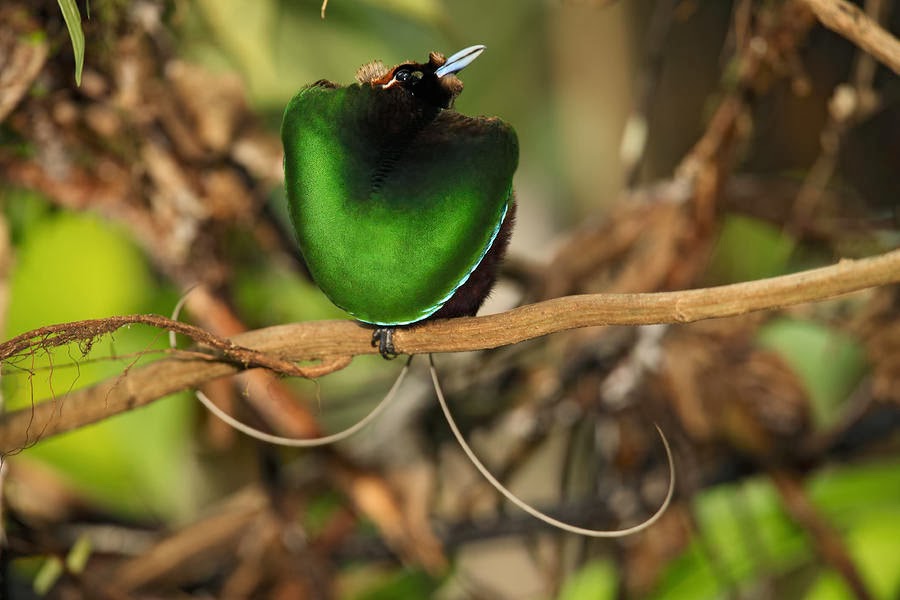
About a week ago I finally got to see some of the "lost" bird-of-paradise specimens at the American Museum of Natural History. Unfortunately I was not allowed to take pictures, but I did make some decisions for myself about whether or not certain forms are hybrids. For example, the specimen of Wilhelmina's Bird of Paradise, which in the book was considered a probable hybrid between the so-called Magnificent and Superb birds of paradise, looked to me very much like a separate species. If it were somehow proven that it was, I think instead of Wilhelmina's it should have a superlative name (taking the example of the Superb and Magnificent), such as the Marvelous, Spectacular or Awesome Bird of Paradise. *
What would a female Superb, accustomed to this...
see in this Magnificent, anyway?
On a related topic, there is another Renaissance Dutch painting reproduced in the Fuller/Attenborough book that is just as thought-provoking as the scene with the owl that I posted about earlier. This is a painting of the Garden of Eden by Jan Brueghel the Elder. (Unfortunately I cannot find a large enough/high resolution enough photo of it online- look it up.) In addition to Greater Birds of Paradise and plenty of other accurately depicted animals, it contains a penguin that appears to have external knees. At the turn of the 17th century, when this was painted, penguins were very poorly known to Western man; it is understandable that certain details of their appearance would be likewise unclear. However, since no living birds have external knees (except for certain domestic breeds of pigeons), some people, such as Brueghel, could have even been uncertain that penguins were birds at all. Judging from the knees that Brueghel gave his penguin, it is likely he thought its closest relative was the frog.
Even as late as 1930 some people thought penguins were plants.
This book sets things straight about penguin knees, by the way.
-Elijah

*I would have put in Wonderful but that name is used for another of the "lost" ones, which, by the way, is almost definitely a hybrid. I can confirm that.

Friday, January 17, 2014

How does this turnstone feel?

Here is a photo that was very recently posted on the Internet Bird Collection. It was taken last summer on an island off the coast of Germany and shows a phalarope apparently picking something off the feathers of a turnstone (the bird that this blog is named for). Though someone who is unfamiliar with these birds could think this is an example of a symbiotic relationship like the one between bee-eaters and bustards in Ethiopia, it is in fact rare and exceptional. Phalaropes usually attract their prey by spinning. Perhaps there was a particularly tasty fly about to bite the turnstone. The phalarope, which (given the time of year) was stopping here on its spring migration to the Arctic, could have been both hungry after a long flight and too tired to do that spinning dance for its food. It wouldn't have cared that the fly it saw was only sitting there because it was busy biting a bird. It is impossible to tell from this photo what exactly is going on, but since the caption says the phalarope is apparently picking insects off, it can be assumed that it isn't simply chasing or harassing the turnstone, which would be much more likely. At any rate, what the phalarope is most decidedly NOT doing is picking bugs off out of empathy for the turnstone.
I'd say the turnstone must be uncomfortable about feeling an unexpected beak on its back.
-Elijah

P. S. There could be another reason that the phalarope is not doing phalaropey things. Unlike most birds, female phalaropes are larger and more dominant and territorial than males. They leave the males to deal with the eggs and chicks. Maybe this male phalarope was simply too nervous to think straight.

Monday, December 16, 2013

Birds of paradise update, plus how to turn hostility toward owls into art

Though I still haven't been shown the bird specimen collection at the American Museum of Natural History since the last post, I did in fact get to meet Errol Fuller, if only for a brief moment. About a month ago I played an "opening set", also at the Museum of Natural History, for a lecture by the author and artist Katrina van Grouw about her book The Unfeathered Bird, which is really cool and I'll probably write a post about it soon. This lecture happened to coincide with a lecture in the museum's other theater by David Attenborough, which was about Drawn from Paradise, a new book he co-wrote with Errol Fuller about the history of the birds of paradise in Western/European culture. Attenborough and Fuller were signing copies of this book after the lecture, so after I saw Katrina van Grouw's presentation I got in line to meet them. I didn't have their book yet, so I had them sign my sheet music.
Recently I got Drawn from Paradise, which is at least as awesome as The Lost Birds of Paradise which my last post was about. I haven't read all of it yet, but so far I haven't found any reference to the other book I wrote about last time, the one by Tim Laman and Ed Scholes (it's not in the index). However, I did notice a few observations about bird of paradise behavior that I thought may have been taken from Laman and Scholes' book. For example, the chapter about the 12-wired Bird of Paradise mentions that the male's special "wire" feathers are used to tickle the female's face, a fact I seem to remember reading that Laman and Scholes had discovered- I'll have to double check. *
One really cool thing I found in Drawn from Paradise relates to a painting, reproduced in the book, which is part of a series by the 17th-century Dutch artist Frans Snyders which depict a large group of birds of different species singing together, with an owl conducting them from a score. Attenborough and Fuller include this painting because there is a Greater Bird of Paradise in it, but their caption also mentions that the inspiration for these paintings may have been the observation of mixed flocks of songbirds converging around a roosting owl and scolding it. A taxidermied version of this behavior, which is known as mobbing, can be seen in the Japanese scene in the Museum of Natural History's hall of Birds of the World. I also wrote a tune that represents mobbing; it is the third movement of Bird Lives. The bass represents the owl.
More updates to come.
-Elijah

*This makes me think of the lonely male 12-wired Bird of Paradise that lived in the Bronx Zoo for much of my life- it needed someone to tickle so it was sent to another zoo in Germany that had a female.

Sunday, October 20, 2013

Birds of paradise, mastery and mystery

Birds of paradise (which, to clarify for non-bird people, are any of about 40 species found in New Guinea and adjacent islands) are among the subjects, in any writing, that induce the most superlatives. Their collective name is one; so are some of the names of the individual species, such as Magnificent Bird of Paradise. This is due not only to their beautifully colored and textured plumage but also their diversity (it is hard to tell that some of them are related to some others), their apparent intelligence and in some cases the inaccessibility of their habitat, in dense rainforest or on remote mountains. It is all well and good to use superlatives about them, but once you’ve got those out of the way, how do you continue? There have been quite a lot of books about birds of paradise, and the ones I’ve read deal with this issue in very different ways.
Greater Bird of Paradise

Tim Laman and Ed Scholes’ book The Birds of Paradise (2012) is the result of eight years of expeditions to observe and document as many aspects of bird-of-paradise life as possible. It is definitely an impressive book, with lots of photos that definitely invite superlatives: many are very close-up and show the birds in action, eating or interacting with each other, often in their courtship displays. Laman and Scholes write about new discoveries regarding the birds’ behavior, as well as possible explanations for how all these diverse species and their lavish appearances could have evolved. This book frequently plunges into the facts after the superlatives are over. It is very precise; Laman and Scholes seem to be on their way toward mastery of their subject.
Laman and Scholes’ book contains many quotations from other bird-of-paradise books. One book that is notably not quoted from is The Lost Birds of Paradise by Errol Fuller (1995). This is a very different book on a slightly different subject: the birds of paradise that were collected and prepared as stuffed specimens, mostly from the 1890s to the 1920s, that are now in museums and do not fit into any of the known species. To me this book is at least, and almost certainly more, interesting than the other one. It is very much a history and extremely well researched; much of it is a skeptical response to the writings of a German biologist in the 1930s who claimed that all of these specimens that do not fit the known species are in fact hybrids. Though Fuller agrees for a few of the specimens, he makes the case for many others not being knowable for certain. Possibly they are separate species that are very rare or extinct; perhaps they are hybrids between other species than was originally assumed. This feeling of mystery serves to make the book particularly awesome, as do old pictures that provide historical context (such as an illustrated poem from some time in the late 19th century criticizing the wanton use of feathers {such as bird-of-paradise feathers} in hats, titled “A Killing Hat”- who knew the use of “killing” as a superlative was that old?). More importantly, Fuller’s book never stops with the superlatives. They don’t get in the way, but they give the book a sense of wonder that I feel is much more overt than in Laman and Scholes’ work, though it is far from lacking in the latter. It is this kind of wonder, I think, that put all the superlatives in the birds’ names in the first place.
-Elijah
P. S. I am trying to set up a opportunity to go behind the scenes at the American Museum of Natural History and see the bird specimen collection, which has many of the “lost” birds of paradise. Expect an update!
One of the "lost" ones. I might get to see these exact feathers!

Wednesday, September 18, 2013

Jam


jam
  1. To cram or crush together; to get stuck.
  2. A fruit preserve/spread.
  3. (music) To improvise collectively; an open-ended session of jazz improvisation.
How do we get the 3rd definition out of the others?
I researched the origin of the “jam” of the jam session and found that there are several theories on where it came from. The most believable is that it was used for situations in which the musicians were jammed together in a tight space. It seems less likely, but still somewhat plausible, that it came partly from a contraction of “jamboree”. A rather unlikely suggestion I also saw is that it came from one particular session (or series of sessions) in which an amateur singer was present who often snapped his fingers on beats 1 and 3 instead of the 2 and 4 that feels better in a jazz setting, thus “jamming” the beat and the groove. (I’ll have to write a whole other post about 1 and 3 vs. 2 and 4- I feel that some people really need to calm down about this.) Though this explanation is almost certainly wrong, it could easily apply to a few of today’s jam sessions.
I feel sorry for pianists, bassists and drummers at jam sessions in certain New York venues such as Smalls, Fat Cat, and Smoke. They have to accompany endless strings of endless horn solos, which are frequently competitive and repetitive (if there was another word that ended in “petitive” I would add it here) and can lack nuance and contrast. The choruses, and eventually the solos themselves, blend into each other and become fungible. No progress can be made and the session is jammed.
If you crush fruit the way jazz is crushed in these sessions, the result is a sort of fruit preserve. Compressed jazz produces a kind of jazz preserve in which traditions get jammed in a sort of suspended animation. These traditions come largely out of the bop of the 1940s-‘60s, such as the almost universal “trading 4’s” and certain solo orders. However, there are somewhat inexplicable newer traditions in these jarfuls of compressed jazz, such as soloists’ avoidance of certain notes (often the roots of the chords, fear of which should be called “rhizophobia”) and the idea that, no matter how many soloists, everyone should remember the order in which they soloed on any given tune so they can trade 4’s with the drums in the same order, minus the bass player. Who said bass and drums can’t trade with each other? Who said remembering the solo order when there were 19 soloists playing 11 choruses each was practical?
In the face of all this thick, slathery, stuck, fruity, preserved jazz spread all over the place, I have searched for jam sessions that neither get jammed nor resemble jam. The Tea Lounge comes close, but enough people show up that the house band (which is awesome) doesn’t get to play once the jam part starts, and then there’s no guarantee there won’t be competitive rhizophobes about, though there is a limit to number of players per tune which helps to keep the solo orders memorable for trading. Last night I went to Mona’s for the first time; I’ll definitely come again. This is specifically a session for “trad” jazz (jazz of the 1920s) and I’m sure overt rhizophobes not tolerated there, though I must say there were a few squishier players who had a harder time filtering the bop influence out. Nobody, however, lost sight of the goal of this session, having a lot of fun with trad jazz, and thus it neither jammed nor resembled a jarful of jam.
Finally, if this was improvised it would be the most awesome jam ever. (I was in the audience at this performance- maybe I'm in the video.)

Elijah

Wednesday, September 11, 2013

Auctioneering as music?


If you haven’t done so already, check this out.

This video calls attention to a tradition that lies on the edge of music. Though I don’t know exactly what auctioneers try to accomplish by jabbering like this (other than excitement and showing off), it seems that the auctioneering chant is considered a skill rather than an art form. Much like traditional Alpine yodeling, it comes from a non-musical background but can definitely be considered musical. The auctioneer seems to be improvising, but within a set form or pattern, reminiscent more of early jazz or perhaps some folk music traditions than the bebop/postbop continuum that dominates modern jazz. The auctioneer’s filler syllables often resemble “bols”, the syllables used for learning tabla drumming (or even more so “konnakol”, the equivalent in southern India for mrudangam drumming). They also remind me of “scat” singing and folk traditions of nonsense syllables, such as Celtic “mouth music” or similar (unfortunately stereotyped) kinds of Eastern European singing. (This particular auctioneer’s filler syllables sound a lot like the “Hi Digga Digga Dum” of these “gypsy” stereotypes.) Unlike yodeling, also a non-verbal vocal tradition, auctioneering’s musical possibilities haven’t been truly explored outside of this video and this song.

There are several possibilities for expanding this tradition musically. I would perhaps like to hear a drummer (or any musician) who has studied the auctioneer-chant tradition enough play along with an auctioneer in real time. This could lead to either having an auctioneer sit in with a band or having a singer, rapper, or beatboxer learn the tradition and work it into something else. With regards to the genre-blending that goes on so much in experimental/postmodern music, why not?
-Elijah

Monday, August 12, 2013

Believing, seeing and does everyone need all of science?

As a bird enthusiast, I find this post highly amusing and also thought-provoking. There's a little bit of jargon here, but to sum it up, this is a hypothetical situation in which an Australian birder, fed up with never seeing uncommon bird species he searches for, decides that these species do not exist. He removes the corresponding pages from his copy of this book, and continues to believe in their non-existence. Eventually, he proposes that Latin names be removed as well (the reason that he gives for this is hilarious!), that English names can be replaced with initials, and that the remaining pages can be taken out once the birds they describe have been seen. This is all in the interest of slimming the book (it's pretty chunky- I have the second edition which is over an inch thick, and the 8th edition probably isn't much thinner, if at all) as well as keeping up disbelief in the existence of uncommon species.
There is much that is obviously fictional here, but some points raised by this situation are worth lingering on. The idea that once a bird is seen, its illustration and account in the book doesn't need to be looked at again is a parody of competitive birders (the famous "twitchers" among Brits*- though "listers" is used more frequently in North America) who seem to watch birds only in the interest of assembling lists of what they have and haven't seen. The point of view in this post seems to be of someone who can't keep up with the "twitchers" (in the British sense) and could be getting back at them by suggesting they're searching for things that don't exist. However, if we get past the humor, it can also be seen as a new system an individual birder has worked out for himself. And it works for him.
Being an attempt by humans to understand the universe, science is artificial. It is not a single dominating truth without alternatives. Nature itself may be more of a truth, and as it flows freely, human endeavors to document it shift. The binomial system of Latin names for species, as invented by Carolus Linnaeus, was perfect for the Enlightenment times he came from, when everyone seemed to be trying to reduce nature to numbers and draw straight lines on it. Since then, lines have bent and blurred; wholes have been seen to exceed the sum of their parts. However, enough aspects of the Enlightenment approach have persisted to make current science a complex hybrid of the objective and the subjective- too complex to be the first thing that comes to mind when nature is perceived firsthand. Not everyone knows science, and though it's often interesting to know science's take on nature, not everyone has to.
With respect to identifying bird species, there are lots of situations in which species are so similar it would take a highly skilled eye and ear to differentiate them (this is the result of lumpers and splitters- but that's a story for another post). Does anyone who's not that curious about what they are need to be able to tell them apart? People get along just fine not knowing the subtlest differences.
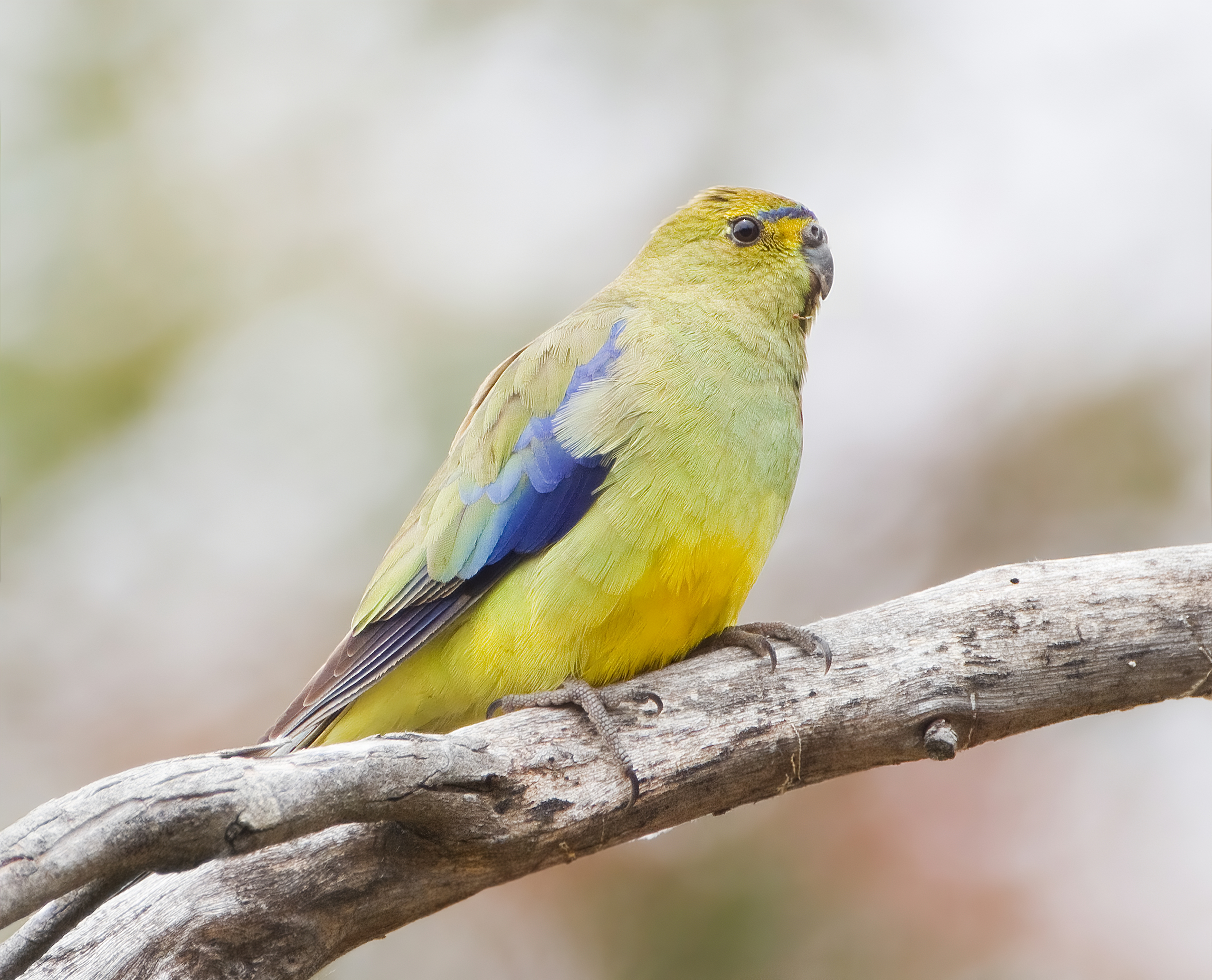
Blue-winged parrot, as mentioned in the post above.
Elegant parrot. I don't blame you if they look the same to you.

It is the same with Latin names- nobody who's not a biologist uses them, but some pretentious "twitchers" (twipsters?) think it's necessary to know them. As Mr. O'Malley notes, the Aborigines don't need to use Latin even in formal occasions. There is not a single instance in which a Latin name is absolutely necessary for a non-scientific birder.
As a birder who is interested in identification by overall impression, I consider the distinctions one makes for themselves more important than the accepted scientific distinctions. As far as Mr. O'Malley's character, he isn't doing anyone a disservice by believing hard-to-identify birds don't exist. He is merely identifying them in his own way, and as long as he isn't trying to communicate with scientists or hardcore birders, no non-scientist or non-hardcore birder would say his system was wrong.
-Elijah

*I hear that in Australia all birders are called "twitchers".