Tuesday, May 27, 2014

New 'monics

As birders know, transliterating bird calls is never accurate or precise. I have read some debates about whether or not it is practical to do so (to form mnemonics for identification), but I generally think it works most of the time. Some people believe the main problem with transliterations is that bird calls often sound like different syllables to different people, and so appear written differently in each book (field guide). I do not consider this a problem, because in my field experience I have imagined words words for bird calls I've heard that are different from what I've seen written in the field guides. Some examples (click on the name of the bird for a link to the recording):
This recording is a little confused because there are a lot of them calling at once, but at certain points you can hear them go "Reykjavik! Reykjavik! Reykjavik!" It's too bad there are no least terns in Iceland.
This is a very variable song but I've found this particular variation to be the most common. It is usually transliterated as "teakettle teakettle teakettle" but I hear "tweet eater tweet eater tweet eater". Does this make more sense or less sense with the advent of Twitter?
Most field guides only transliterate the "type A" song of the yellow warbler, usually as "sweet sweet sweet sugary sweet!", which is accurate. However, I have often found the "type B" song, which is easily confused with those of some other warblers, to be just as common. Because the similar song of the chestnut-sided warbler used to be written "see see see Ms. Beecher", I put in a name for this yellow warbler song as well. I hear it as "see see see Chester Biddlechick".
I haven't seen this written out as words, but I hear "chewy chewy chewy chewy cheeeeese!!" (The first time on this recording is at 0:12)
This one really ruffles my feathers. In every field guide I've seen, this has been written as a hard or hoarse "chip-burr" or something like that - in a couple of cases "chip-churr" and in one instance even described as a dry rattle! The Audubon Society field guide comes closer by using the adjective "twanging", but still it transliterates it as "chip-burr". Nowhere does anyone come close to the metallic ringing quality I hear in this sound. I have always heard it as "tick-bang". The field guide descriptions actually led me astray, and before I saw a scarlet tanager making this sound, I couldn't identify the sound. Go out to your nearest woods or large park (if you're in eastern North America) and try to find this sound. It's a relatively common bird and they're nesting now. Tell me it isn't "tick-bang"!
-Elijah

Sunday, February 16, 2014

Birds of paradise- final update: penguins and knees

About a week ago I finally got to see some of the "lost" bird-of-paradise specimens at the American Museum of Natural History. Unfortunately I was not allowed to take pictures, but I did make some decisions for myself about whether or not certain forms are hybrids. For example, the specimen of Wilhelmina's Bird of Paradise, which in the book was considered a probable hybrid between the so-called Magnificent and Superb birds of paradise, looked to me very much like a separate species. If it were somehow proven that it was, I think instead of Wilhelmina's it should have a superlative name (taking the example of the Superb and Magnificent), such as the Marvelous, Spectacular or Awesome Bird of Paradise. *
What would a female Superb, accustomed to this...
see in this Magnificent, anyway?
On a related topic, there is another Renaissance Dutch painting reproduced in the Fuller/Attenborough book that is just as thought-provoking as the scene with the owl that I posted about earlier. This is a painting of the Garden of Eden by Jan Brueghel the Elder. (Unfortunately I cannot find a large enough/high resolution enough photo of it online- look it up.) In addition to Greater Birds of Paradise and plenty of other accurately depicted animals, it contains a penguin that appears to have external knees. At the turn of the 17th century, when this was painted, penguins were very poorly known to Western man; it is understandable that certain details of their appearance would be likewise unclear. However, since no living birds have external knees (except for certain domestic breeds of pigeons), some people, such as Brueghel, could have even been uncertain that penguins were birds at all. Judging from the knees that Brueghel gave his penguin, it is likely he thought its closest relative was the frog.
Even as late as 1930 some people thought penguins were plants.
This book sets things straight about penguin knees, by the way.
-Elijah

*I would have put in Wonderful but that name is used for another of the "lost" ones, which, by the way, is almost definitely a hybrid. I can confirm that.

Friday, January 17, 2014

How does this turnstone feel?

Here is a photo that was very recently posted on the Internet Bird Collection. It was taken last summer on an island off the coast of Germany and shows a phalarope apparently picking something off the feathers of a turnstone (the bird that this blog is named for). Though someone who is unfamiliar with these birds could think this is an example of a symbiotic relationship like the one between bee-eaters and bustards in Ethiopia, it is in fact rare and exceptional. Phalaropes usually attract their prey by spinning. Perhaps there was a particularly tasty fly about to bite the turnstone. The phalarope, which (given the time of year) was stopping here on its spring migration to the Arctic, could have been both hungry after a long flight and too tired to do that spinning dance for its food. It wouldn't have cared that the fly it saw was only sitting there because it was busy biting a bird. It is impossible to tell from this photo what exactly is going on, but since the caption says the phalarope is apparently picking insects off, it can be assumed that it isn't simply chasing or harassing the turnstone, which would be much more likely. At any rate, what the phalarope is most decidedly NOT doing is picking bugs off out of empathy for the turnstone.
I'd say the turnstone must be uncomfortable about feeling an unexpected beak on its back.
-Elijah

P. S. There could be another reason that the phalarope is not doing phalaropey things. Unlike most birds, female phalaropes are larger and more dominant and territorial than males. They leave the males to deal with the eggs and chicks. Maybe this male phalarope was simply too nervous to think straight.

Monday, December 16, 2013

Birds of paradise update, plus how to turn hostility toward owls into art

Though I still haven't been shown the bird specimen collection at the American Museum of Natural History since the last post, I did in fact get to meet Errol Fuller, if only for a brief moment. About a month ago I played an "opening set", also at the Museum of Natural History, for a lecture by the author and artist Katrina van Grouw about her book The Unfeathered Bird, which is really cool and I'll probably write a post about it soon. This lecture happened to coincide with a lecture in the museum's other theater by David Attenborough, which was about Drawn from Paradise, a new book he co-wrote with Errol Fuller about the history of the birds of paradise in Western/European culture. Attenborough and Fuller were signing copies of this book after the lecture, so after I saw Katrina van Grouw's presentation I got in line to meet them. I didn't have their book yet, so I had them sign my sheet music.
Recently I got Drawn from Paradise, which is at least as awesome as The Lost Birds of Paradise which my last post was about. I haven't read all of it yet, but so far I haven't found any reference to the other book I wrote about last time, the one by Tim Laman and Ed Scholes (it's not in the index). However, I did notice a few observations about bird of paradise behavior that I thought may have been taken from Laman and Scholes' book. For example, the chapter about the 12-wired Bird of Paradise mentions that the male's special "wire" feathers are used to tickle the female's face, a fact I seem to remember reading that Laman and Scholes had discovered- I'll have to double check. *
One really cool thing I found in Drawn from Paradise relates to a painting, reproduced in the book, which is part of a series by the 17th-century Dutch artist Frans Snyders which depict a large group of birds of different species singing together, with an owl conducting them from a score. Attenborough and Fuller include this painting because there is a Greater Bird of Paradise in it, but their caption also mentions that the inspiration for these paintings may have been the observation of mixed flocks of songbirds converging around a roosting owl and scolding it. A taxidermied version of this behavior, which is known as mobbing, can be seen in the Japanese scene in the Museum of Natural History's hall of Birds of the World. I also wrote a tune that represents mobbing; it is the third movement of Bird Lives. The bass represents the owl.
More updates to come.
-Elijah

*This makes me think of the lonely male 12-wired Bird of Paradise that lived in the Bronx Zoo for much of my life- it needed someone to tickle so it was sent to another zoo in Germany that had a female.

Sunday, October 20, 2013

Birds of paradise, mastery and mystery

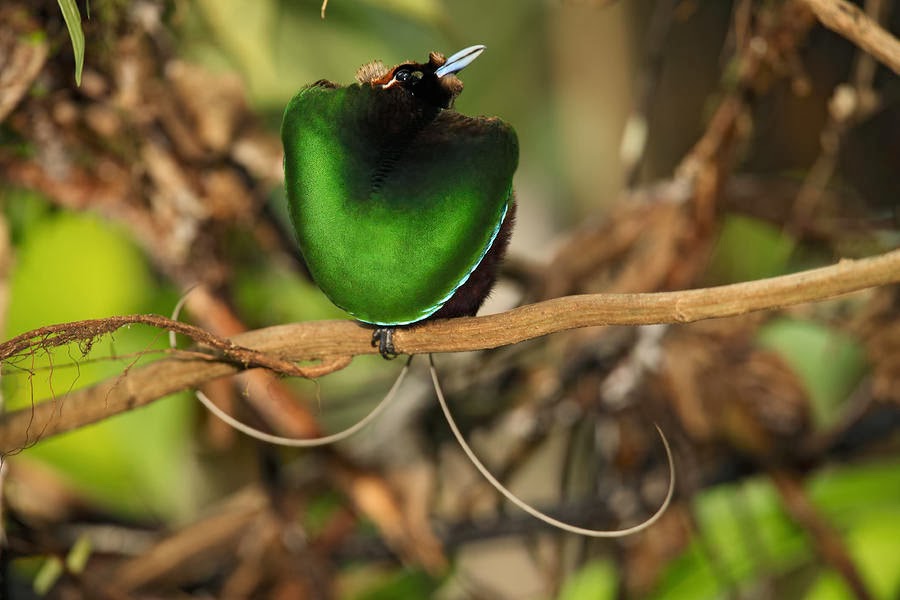
Birds of paradise (which, to clarify for non-bird people, are any of about 40 species found in New Guinea and adjacent islands) are among the subjects, in any writing, that induce the most superlatives. Their collective name is one; so are some of the names of the individual species, such as Magnificent Bird of Paradise. This is due not only to their beautifully colored and textured plumage but also their diversity (it is hard to tell that some of them are related to some others), their apparent intelligence and in some cases the inaccessibility of their habitat, in dense rainforest or on remote mountains. It is all well and good to use superlatives about them, but once you’ve got those out of the way, how do you continue? There have been quite a lot of books about birds of paradise, and the ones I’ve read deal with this issue in very different ways.
Greater Bird of Paradise

Tim Laman and Ed Scholes’ book The Birds of Paradise (2012) is the result of eight years of expeditions to observe and document as many aspects of bird-of-paradise life as possible. It is definitely an impressive book, with lots of photos that definitely invite superlatives: many are very close-up and show the birds in action, eating or interacting with each other, often in their courtship displays. Laman and Scholes write about new discoveries regarding the birds’ behavior, as well as possible explanations for how all these diverse species and their lavish appearances could have evolved. This book frequently plunges into the facts after the superlatives are over. It is very precise; Laman and Scholes seem to be on their way toward mastery of their subject.
Laman and Scholes’ book contains many quotations from other bird-of-paradise books. One book that is notably not quoted from is The Lost Birds of Paradise by Errol Fuller (1995). This is a very different book on a slightly different subject: the birds of paradise that were collected and prepared as stuffed specimens, mostly from the 1890s to the 1920s, that are now in museums and do not fit into any of the known species. To me this book is at least, and almost certainly more, interesting than the other one. It is very much a history and extremely well researched; much of it is a skeptical response to the writings of a German biologist in the 1930s who claimed that all of these specimens that do not fit the known species are in fact hybrids. Though Fuller agrees for a few of the specimens, he makes the case for many others not being knowable for certain. Possibly they are separate species that are very rare or extinct; perhaps they are hybrids between other species than was originally assumed. This feeling of mystery serves to make the book particularly awesome, as do old pictures that provide historical context (such as an illustrated poem from some time in the late 19th century criticizing the wanton use of feathers {such as bird-of-paradise feathers} in hats, titled “A Killing Hat”- who knew the use of “killing” as a superlative was that old?). More importantly, Fuller’s book never stops with the superlatives. They don’t get in the way, but they give the book a sense of wonder that I feel is much more overt than in Laman and Scholes’ work, though it is far from lacking in the latter. It is this kind of wonder, I think, that put all the superlatives in the birds’ names in the first place.
-Elijah
P. S. I am trying to set up a opportunity to go behind the scenes at the American Museum of Natural History and see the bird specimen collection, which has many of the “lost” birds of paradise. Expect an update!
One of the "lost" ones. I might get to see these exact feathers!

Wednesday, September 18, 2013

Jam


jam
  1. To cram or crush together; to get stuck.
  2. A fruit preserve/spread.
  3. (music) To improvise collectively; an open-ended session of jazz improvisation.
How do we get the 3rd definition out of the others?
I researched the origin of the “jam” of the jam session and found that there are several theories on where it came from. The most believable is that it was used for situations in which the musicians were jammed together in a tight space. It seems less likely, but still somewhat plausible, that it came partly from a contraction of “jamboree”. A rather unlikely suggestion I also saw is that it came from one particular session (or series of sessions) in which an amateur singer was present who often snapped his fingers on beats 1 and 3 instead of the 2 and 4 that feels better in a jazz setting, thus “jamming” the beat and the groove. (I’ll have to write a whole other post about 1 and 3 vs. 2 and 4- I feel that some people really need to calm down about this.) Though this explanation is almost certainly wrong, it could easily apply to a few of today’s jam sessions.
I feel sorry for pianists, bassists and drummers at jam sessions in certain New York venues such as Smalls, Fat Cat, and Smoke. They have to accompany endless strings of endless horn solos, which are frequently competitive and repetitive (if there was another word that ended in “petitive” I would add it here) and can lack nuance and contrast. The choruses, and eventually the solos themselves, blend into each other and become fungible. No progress can be made and the session is jammed.
If you crush fruit the way jazz is crushed in these sessions, the result is a sort of fruit preserve. Compressed jazz produces a kind of jazz preserve in which traditions get jammed in a sort of suspended animation. These traditions come largely out of the bop of the 1940s-‘60s, such as the almost universal “trading 4’s” and certain solo orders. However, there are somewhat inexplicable newer traditions in these jarfuls of compressed jazz, such as soloists’ avoidance of certain notes (often the roots of the chords, fear of which should be called “rhizophobia”) and the idea that, no matter how many soloists, everyone should remember the order in which they soloed on any given tune so they can trade 4’s with the drums in the same order, minus the bass player. Who said bass and drums can’t trade with each other? Who said remembering the solo order when there were 19 soloists playing 11 choruses each was practical?
In the face of all this thick, slathery, stuck, fruity, preserved jazz spread all over the place, I have searched for jam sessions that neither get jammed nor resemble jam. The Tea Lounge comes close, but enough people show up that the house band (which is awesome) doesn’t get to play once the jam part starts, and then there’s no guarantee there won’t be competitive rhizophobes about, though there is a limit to number of players per tune which helps to keep the solo orders memorable for trading. Last night I went to Mona’s for the first time; I’ll definitely come again. This is specifically a session for “trad” jazz (jazz of the 1920s) and I’m sure overt rhizophobes not tolerated there, though I must say there were a few squishier players who had a harder time filtering the bop influence out. Nobody, however, lost sight of the goal of this session, having a lot of fun with trad jazz, and thus it neither jammed nor resembled a jarful of jam.
Finally, if this was improvised it would be the most awesome jam ever. (I was in the audience at this performance- maybe I'm in the video.)

Elijah

Wednesday, September 11, 2013

Auctioneering as music?


If you haven’t done so already, check this out.

This video calls attention to a tradition that lies on the edge of music. Though I don’t know exactly what auctioneers try to accomplish by jabbering like this (other than excitement and showing off), it seems that the auctioneering chant is considered a skill rather than an art form. Much like traditional Alpine yodeling, it comes from a non-musical background but can definitely be considered musical. The auctioneer seems to be improvising, but within a set form or pattern, reminiscent more of early jazz or perhaps some folk music traditions than the bebop/postbop continuum that dominates modern jazz. The auctioneer’s filler syllables often resemble “bols”, the syllables used for learning tabla drumming (or even more so “konnakol”, the equivalent in southern India for mrudangam drumming). They also remind me of “scat” singing and folk traditions of nonsense syllables, such as Celtic “mouth music” or similar (unfortunately stereotyped) kinds of Eastern European singing. (This particular auctioneer’s filler syllables sound a lot like the “Hi Digga Digga Dum” of these “gypsy” stereotypes.) Unlike yodeling, also a non-verbal vocal tradition, auctioneering’s musical possibilities haven’t been truly explored outside of this video and this song.

There are several possibilities for expanding this tradition musically. I would perhaps like to hear a drummer (or any musician) who has studied the auctioneer-chant tradition enough play along with an auctioneer in real time. This could lead to either having an auctioneer sit in with a band or having a singer, rapper, or beatboxer learn the tradition and work it into something else. With regards to the genre-blending that goes on so much in experimental/postmodern music, why not?
-Elijah